

【请大家参与评论】H‑1B 申请拟额外收费 $103,265,境内外申请均受影响 H1B
H1B
日光
美国国土安全部(DHS)近日发布了一项 H1B 新规提案:针对每一份受年度名额限制、需要参加抽签的 H1B 申请,在现有申请费用之外,再向雇主额外收取 $103,265。
这项费用适用于所有 Cap-subject H1B 申请,无论申请人目前人在美国境内通过 Change of Status 转换身份,还是人在美国境外通过领事程序申请签证,都会受到影响。
需要强调的是,这项提案目前尚未生效,仍处于公众意见征集阶段。希望所有在美国留学、求职或工作的朋友都能花几分钟提交评论。
📅 评论截止时间:2026年9月24日(美东时间)
📝 提交评论:
www.regulations.gov/commenton/USC...026-0298-0001
📄 提案原文:
www.regulations.gov/document/USCI...026-0298-0001
评论不需要写得很长,重点是清楚表达自己的观点。如果能结合个人的留学、求职、工作、招聘或创业经历,说明这项额外费用可能造成的实际影响,会更有说服力。建议大家尽量使用自己的语言,不要完全复制相同模板。
请大家积极参与,也欢迎转发给身边的留学生和在美工作者,让更多可能受到影响的人看到。
这项费用适用于所有 Cap-subject H1B 申请,无论申请人目前人在美国境内通过 Change of Status 转换身份,还是人在美国境外通过领事程序申请签证,都会受到影响。
需要强调的是,这项提案目前尚未生效,仍处于公众意见征集阶段。希望所有在美国留学、求职或工作的朋友都能花几分钟提交评论。
📅 评论截止时间:2026年9月24日(美东时间)
📝 提交评论:
www.regulations.gov/commenton/USC...026-0298-0001
📄 提案原文:
www.regulations.gov/document/USCI...026-0298-0001
评论不需要写得很长,重点是清楚表达自己的观点。如果能结合个人的留学、求职、工作、招聘或创业经历,说明这项额外费用可能造成的实际影响,会更有说服力。建议大家尽量使用自己的语言,不要完全复制相同模板。
请大家积极参与,也欢迎转发给身边的留学生和在美工作者,让更多可能受到影响的人看到。
已获得 46 大米


+2
共117条回复
虎目龙眉的鸡蛋
置顶
下面,是纽约曾琦律师提供的评论思路,也非常合理,大家可参考提交自己的评论!cravenbrave 发表于除了上面评论里的观点还有以下补充的观点,供参考
1. 对美国大学(Higher Education)的打击: 绝大多数 Cap-subject H-1B 属于在
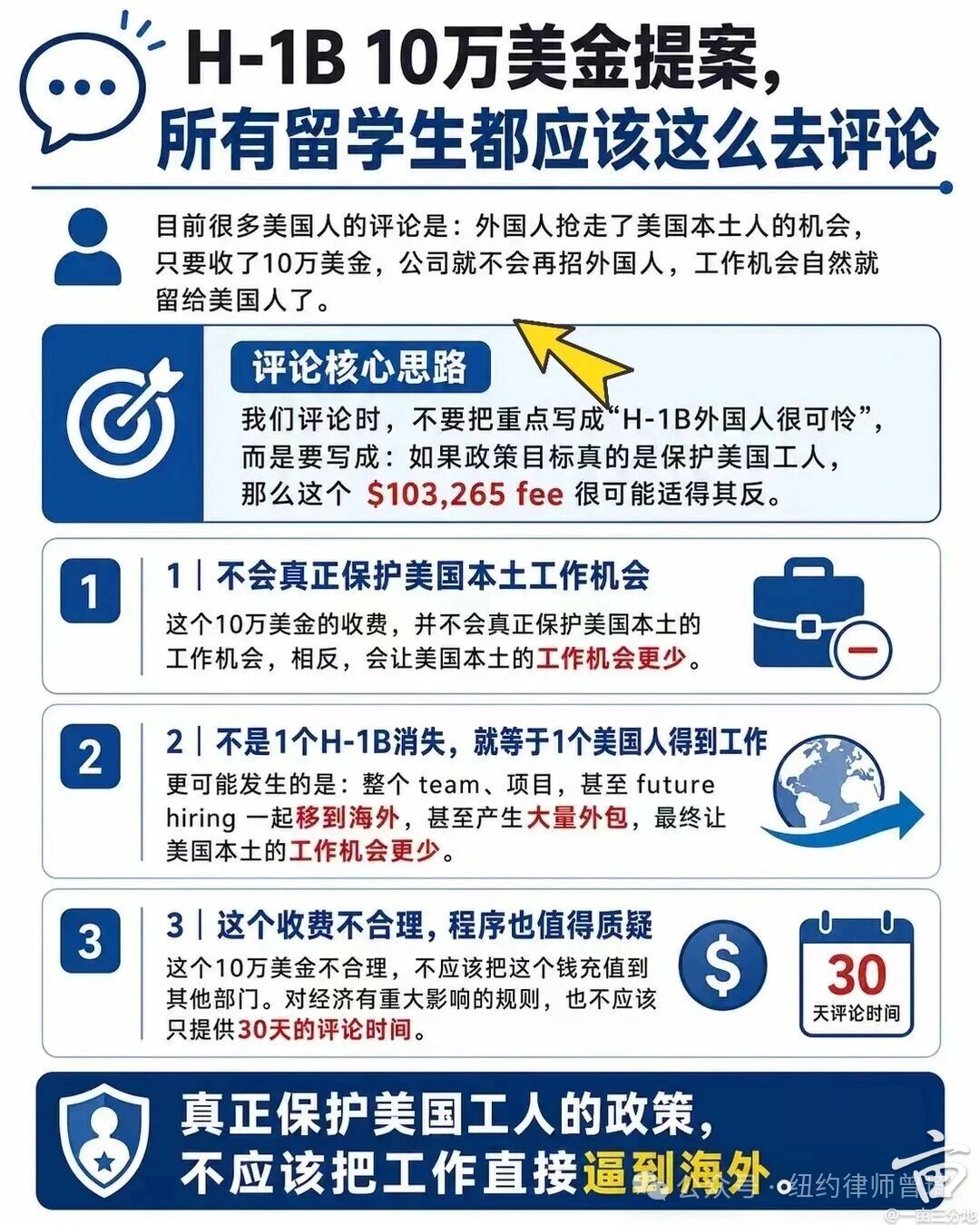
已获得 4 大米


+1
锦晖律师事务所
置顶
Comment 1:费用和 adjudication cost 不匹配
I respectfully oppose the proposed $103,265 H-1B fee because the amount does not appear reasonably tied to the actual cost of adjudicating an H-1B petition.
The proposed rule appears to calculate the fee by dividing approximately $8.8 billion in projected immigration-system costs by 85,000 cap-subject H-1B petitions. This methodology raises serious concerns. A filing fee should be connected to the cost of processing the benefit request. Here, the proposed amount appears to function as a broad revenue mechanism for multiple agencies and programs, rather than a fee based on the actual cost of adjudicating an H-1B petition.
H-1B employers already pay multiple fees, including the Form I-129 filing fee, ACWIA fee, fraud prevention and detection fee, asylum program fee where applicable, and premium processing fee if requested. Employers also pay legal fees, compliance costs, LCA-related costs, and internal HR costs. Adding another $103,265 fee on top of those existing costs would create an extraordinary burden.
DHS should explain why cap-subject H-1B petitioners should be responsible for broad immigration-system costs that are not directly connected to the adjudication of their own H-1B petitions. For example, if part of the revenue is intended to support broader immigration courts, enforcement, consular operations, or labor programs, DHS should explain why those costs should be imposed specifically on H-1B cap-subject employers rather than funded through ordinary appropriations or more broadly distributed fees.
I request that DHS withdraw the proposed rule or revise it so that any H-1B fee is limited to the reasonable cost of processing, adjudicating, and administering H-1B petitions.
Comment 2:岗位外包 / 美国竞争力角度
I respectfully oppose the proposed $103,265 H-1B fee because it may produce the opposite of its stated goal.
If U.S. employers cannot afford to sponsor highly skilled workers in the United States, some employers may not hire a U.S. worker as a substitute. Instead, they may move the work abroad, reduce U.S.-based hiring, delay projects, or shift investment to countries with more predictable immigration systems. This would harm U.S. competitiveness and may reduce, rather than protect, U.S. jobs.
For example, if a U.S. company cannot sponsor an engineer, researcher, data scientist, architect, healthcare professional, or other specialized worker because of a six-figure filing fee, the company may decide to build the team outside the United States. Once a project or team moves abroad, related jobs, management roles, tax revenue, intellectual property development, and future business growth may also move away from the United States.
The H-1B program is often used when employers need specialized skills. A fee of this size does not solve skill shortages. It simply makes lawful U.S.-based employment more expensive and less predictable. In practice, the rule could weaken U.S. innovation by making it harder for companies to hire and retain specialized talent in the United States.
DHS should withdraw the proposed rule and conduct a more complete economic analysis of how the fee would affect offshoring, project location decisions, innovation, startup formation, university-to-workforce pipelines, and U.S. competitiveness.
Comment 3:F-1 / OPT / STEM OPT 学生角度
I respectfully oppose the proposed $103,265 additional fee for H-1B cap-subject petitions.
As an international student / recent U.S. graduate, I invested substantial time, tuition, and effort in obtaining a U.S. education. Many students like me studied in the United States because U.S. universities, research programs, and employers attract global talent. After graduation, F-1 OPT and STEM OPT provide a limited period of work authorization, but the H-1B program is often the only realistic pathway for U.S.-educated graduates to continue working lawfully in the United States.
A $103,265 filing fee would make that pathway unavailable for many people, even when the employer has a legitimate need for the worker’s skills. For example, an employer considering a recent graduate for a software engineer, data analyst, biomedical researcher, accountant, teacher, or engineering role may decide that the additional six-figure fee is too expensive, even if the candidate was trained in the United States and is fully qualified for the position.
This would not only harm foreign graduates. It would also reduce the value of U.S. higher education, discourage future international students from choosing U.S. universities, and push U.S.-trained talent to other countries with more predictable immigration systems. The United States benefits when people educated here can contribute here, pay taxes here, and help U.S. companies grow.
I ask DHS to withdraw the proposed fee or, at minimum, create exemptions or reduced fees for U.S. degree holders, F-1 OPT / STEM OPT workers, early-career workers, and employers that cannot reasonably absorb a six-figure filing cost.
Comment 4:Small business / startup 角度
I respectfully oppose the proposed $103,265 additional fee for H-1B cap-subject petitions because it would disproportionately harm small businesses and startups.
A large corporation may be able to absorb a six-figure fee, but many small businesses cannot. For a startup or small employer, $103,265 may equal several months of payroll, the cost of another employee, or the budget for an entire project. If a small company needs one specialized employee, the proposed fee may make sponsorship impossible even when the company has a real business need and cannot easily find a qualified alternative.
For example, a startup hiring its first machine learning engineer, biotech researcher, chip design engineer, product designer, or specialized accountant may not have the cash flow to pay more than $100,000 in additional government fees before the worker even begins long-term employment. This may force the company to delay hiring, cancel projects, move work offshore, or lose competitiveness to larger companies.
The proposed rule therefore may not protect U.S. workers in practice. Instead, it may concentrate H-1B sponsorship among the largest employers while excluding smaller employers, startups, and regional businesses from competing for skilled talent. That would reduce competition and innovation in the U.S. labor market.
DHS should consider less burdensome alternatives, including withdrawing the fee, substantially reducing it, creating a small-business exemption, phasing any fee based on employer size or revenue, or applying a lower fee to first-time small-business sponsors.
I respectfully oppose the proposed $103,265 H-1B fee because the amount does not appear reasonably tied to the actual cost of adjudicating an H-1B petition.
The proposed rule appears to calculate the fee by dividing approximately $8.8 billion in projected immigration-system costs by 85,000 cap-subject H-1B petitions. This methodology raises serious concerns. A filing fee should be connected to the cost of processing the benefit request. Here, the proposed amount appears to function as a broad revenue mechanism for multiple agencies and programs, rather than a fee based on the actual cost of adjudicating an H-1B petition.
H-1B employers already pay multiple fees, including the Form I-129 filing fee, ACWIA fee, fraud prevention and detection fee, asylum program fee where applicable, and premium processing fee if requested. Employers also pay legal fees, compliance costs, LCA-related costs, and internal HR costs. Adding another $103,265 fee on top of those existing costs would create an extraordinary burden.
DHS should explain why cap-subject H-1B petitioners should be responsible for broad immigration-system costs that are not directly connected to the adjudication of their own H-1B petitions. For example, if part of the revenue is intended to support broader immigration courts, enforcement, consular operations, or labor programs, DHS should explain why those costs should be imposed specifically on H-1B cap-subject employers rather than funded through ordinary appropriations or more broadly distributed fees.
I request that DHS withdraw the proposed rule or revise it so that any H-1B fee is limited to the reasonable cost of processing, adjudicating, and administering H-1B petitions.
Comment 2:岗位外包 / 美国竞争力角度
I respectfully oppose the proposed $103,265 H-1B fee because it may produce the opposite of its stated goal.
If U.S. employers cannot afford to sponsor highly skilled workers in the United States, some employers may not hire a U.S. worker as a substitute. Instead, they may move the work abroad, reduce U.S.-based hiring, delay projects, or shift investment to countries with more predictable immigration systems. This would harm U.S. competitiveness and may reduce, rather than protect, U.S. jobs.
For example, if a U.S. company cannot sponsor an engineer, researcher, data scientist, architect, healthcare professional, or other specialized worker because of a six-figure filing fee, the company may decide to build the team outside the United States. Once a project or team moves abroad, related jobs, management roles, tax revenue, intellectual property development, and future business growth may also move away from the United States.
The H-1B program is often used when employers need specialized skills. A fee of this size does not solve skill shortages. It simply makes lawful U.S.-based employment more expensive and less predictable. In practice, the rule could weaken U.S. innovation by making it harder for companies to hire and retain specialized talent in the United States.
DHS should withdraw the proposed rule and conduct a more complete economic analysis of how the fee would affect offshoring, project location decisions, innovation, startup formation, university-to-workforce pipelines, and U.S. competitiveness.
Comment 3:F-1 / OPT / STEM OPT 学生角度
I respectfully oppose the proposed $103,265 additional fee for H-1B cap-subject petitions.
As an international student / recent U.S. graduate, I invested substantial time, tuition, and effort in obtaining a U.S. education. Many students like me studied in the United States because U.S. universities, research programs, and employers attract global talent. After graduation, F-1 OPT and STEM OPT provide a limited period of work authorization, but the H-1B program is often the only realistic pathway for U.S.-educated graduates to continue working lawfully in the United States.
A $103,265 filing fee would make that pathway unavailable for many people, even when the employer has a legitimate need for the worker’s skills. For example, an employer considering a recent graduate for a software engineer, data analyst, biomedical researcher, accountant, teacher, or engineering role may decide that the additional six-figure fee is too expensive, even if the candidate was trained in the United States and is fully qualified for the position.
This would not only harm foreign graduates. It would also reduce the value of U.S. higher education, discourage future international students from choosing U.S. universities, and push U.S.-trained talent to other countries with more predictable immigration systems. The United States benefits when people educated here can contribute here, pay taxes here, and help U.S. companies grow.
I ask DHS to withdraw the proposed fee or, at minimum, create exemptions or reduced fees for U.S. degree holders, F-1 OPT / STEM OPT workers, early-career workers, and employers that cannot reasonably absorb a six-figure filing cost.
Comment 4:Small business / startup 角度
I respectfully oppose the proposed $103,265 additional fee for H-1B cap-subject petitions because it would disproportionately harm small businesses and startups.
A large corporation may be able to absorb a six-figure fee, but many small businesses cannot. For a startup or small employer, $103,265 may equal several months of payroll, the cost of another employee, or the budget for an entire project. If a small company needs one specialized employee, the proposed fee may make sponsorship impossible even when the company has a real business need and cannot easily find a qualified alternative.
For example, a startup hiring its first machine learning engineer, biotech researcher, chip design engineer, product designer, or specialized accountant may not have the cash flow to pay more than $100,000 in additional government fees before the worker even begins long-term employment. This may force the company to delay hiring, cancel projects, move work offshore, or lose competitiveness to larger companies.
The proposed rule therefore may not protect U.S. workers in practice. Instead, it may concentrate H-1B sponsorship among the largest employers while excluding smaller employers, startups, and regional businesses from competing for skilled talent. That would reduce competition and innovation in the U.S. labor market.
DHS should consider less burdensome alternatives, including withdrawing the fee, substantially reducing it, creating a small-business exemption, phasing any fee based on employer size or revenue, or applying a lower fee to first-time small-business sponsors.
已获得 10 大米


+2
Syd_
置顶
建议大家去评论反对的时候从这条rule的论点和依据去攻击(主要是为什么要收钱,用途是什么,怎么计算出来的等等),可以让ai帮读和总结攻击的论点论据,而不是只泛泛而谈会影响tech公司和美国技术发展啥的。这样substantial的comment才是日后可以起诉程序违法的重要证据
已获得 13 大米


+2
cravenbrave
置顶
除了上面评论里的观点还有以下补充的观点,供参考
1. 对美国大学(Higher Education)的打击: 绝大多数 Cap-subject H-1B 属于在美国拿了 Master/PhD 的留学生(Change of Status)。这一政策会直接腰斩美国高等教育对全球顶尖 STEM 生源的吸引力,导致人才直接流向加拿大、欧洲等政策更友好的国家。
2. 中小企业(Small Business & Startups)被挤出: 10 万美元的额外成本对于巨头科技公司来说或许可以咬牙承受,但会彻底抹杀初创公司和中小企业引进关键技术人才的可能,直接破坏市场自由竞争。
3. 法律越权风险(Statutory Authority): DHS 试图通过行政规章收取数十亿资金用于填补整个移民系统的运营预算,这超出了《移民与国籍法》(INA)授权 USCIS “仅按实际审理成本收费”的法律边界,本质上是一种未经国会授权的非法征税。
我还参考了之前评论里的另外两个观点:
除了经济层面的扭曲,该政策还会带来以下不可忽视的隐患:
摧毁美国高等教育与 STEM 竞争力: 这切断了美国高校培养的优秀留学生的留美通道。外国顶尖人才将转向加拿大、欧洲或澳大利亚,导致美国大学失去重要学费来源和顶尖研究力量。
人才流失与创新中心外移: 强制企业将岗位外包,意味着核心知识产权、研发中心以及相关的税收收入将永久离开美国,最终削弱美国的全球科技领先地位。
1. 对美国大学(Higher Education)的打击: 绝大多数 Cap-subject H-1B 属于在美国拿了 Master/PhD 的留学生(Change of Status)。这一政策会直接腰斩美国高等教育对全球顶尖 STEM 生源的吸引力,导致人才直接流向加拿大、欧洲等政策更友好的国家。
2. 中小企业(Small Business & Startups)被挤出: 10 万美元的额外成本对于巨头科技公司来说或许可以咬牙承受,但会彻底抹杀初创公司和中小企业引进关键技术人才的可能,直接破坏市场自由竞争。
3. 法律越权风险(Statutory Authority): DHS 试图通过行政规章收取数十亿资金用于填补整个移民系统的运营预算,这超出了《移民与国籍法》(INA)授权 USCIS “仅按实际审理成本收费”的法律边界,本质上是一种未经国会授权的非法征税。
我还参考了之前评论里的另外两个观点:
除了经济层面的扭曲,该政策还会带来以下不可忽视的隐患:
摧毁美国高等教育与 STEM 竞争力: 这切断了美国高校培养的优秀留学生的留美通道。外国顶尖人才将转向加拿大、欧洲或澳大利亚,导致美国大学失去重要学费来源和顶尖研究力量。
人才流失与创新中心外移: 强制企业将岗位外包,意味着核心知识产权、研发中心以及相关的税收收入将永久离开美国,最终削弱美国的全球科技领先地位。
已获得 22 大米

+2
mxj
置顶
希望管理员把这么重要的帖子置顶。写评论从来不是看支持的人多还是反对的人多的投票,而是给你个机会让你质疑其中不合理的地方。原则上dhs需要在final rule里面address所有有实质意义的质疑才可以。如果没有address哪怕一条可能动摇规则基本前提的重要问题,即使dhs执意要发布final rule,之后都可以主张规则arbitrary and capricious去起诉dhs。不写comment的话,等final rule出来后再去起诉dhs,法院反而可以问你早干嘛去了,为什么不在comment period提出质疑。一条well-written的反对的comment胜过一千条没有任何证据只是空泛叫好支持comment。更何况退一万步讲,写comment再没用也比什么也不干只抱怨强。
补充内容
写评论不是指望 DHS 一定能回心转意,而是把规则中站不住脚的问题正式写入行政记录,迫使 DHS 在发布 final rule 时作出回应。逼着它要么对足以动摇规则基础的重要问题避而不答,为之后以 arbitrary and capricious 为由起诉留下把柄,要么勉强辩解,把漏洞直接写进自己的回复,给今后任何起诉DHS的人提供更明确的攻击点。已获得 17 大米

+2
✨ 您正在体验新版论坛UI

